
To get an understanding of what cancer cells are we need know how normal cells live.
Normal cells are controlled by signals .these signals are produced by neighbouring cells or other cells far away from a cell.
These signals direct the cell to divide, differentiate, die proliferate.
Cancer cells are cells that develop a degree of autonomy over these signals and hence resulting into uncontrolled cell growth and proliferation.
Instructions for live is called the genetic material it can either be a DNA or an RNA depending on the species of the organism.
These instruction are specific for different actions, any change in a set of instruction can cause failure of a particular appropriate message being generated.
Changes in these sets of instruction are termed as mutation which can cause cancer.
Cancer cells undergo uncontrolled proliferation; escape apoptosis undergo continuous growth and cell division.
Apoptosis, cell division rate, rate of cell growth are controlled by particular set of instructions .so for a normal cell to transform in to a cancerous cell, it has to undergo series of mutations the first mutation may be to escape apoptosis then next mutation could be for high rate of cell division, series of mutation occurs before a normal cell fully transforms into a cancerous cell .this could take months or years .so as a person ages the chances of developing cancer increases.
Cancer is deadly because it interferes with function of organs, nerves or blood vessels.
Immortality ,cancer cells have infinite life span unlike normal cells which have finite life span which die after sometime.
Continuous division.as normal cell waits for a go signal for initiation of cell division cancer cells can produce their own go signals to initiate cell division.
Stop signals: normal cells are subjected to stop signals to stop cell division, cancer cells escape cell division these stop signals.
Escape apoptosis: unlike cancer cells normal cells sometimes respond to stress by triggering self-destruction
Angiogenesis: as a competitive strategy cancer cells sprout new blood vessels to ensure enough supply of nutrients for their continuous growth.
The six things about the general science of cancer.
Immortality:
Cultured cells undergo finite number of divisions before stopping completely
Leonard hayflick showed that cells from a rodent or human embryo have finite number of divisions he called this senescence.
It has been discovered that telomeres at end of chromosomes control senescence.
Telomeres are hexanucleotide sequence of DNA at each end of a linear chromosome there are copies of these repeats.
For example in humans the repeat sequence is TTAGGG this sequence are called junk as they do not code for any protein.
The importance of telomeres comes in preventing end to end fusion in linear chromosome and shielding the DNA from degradation by nucleases.
After each round of DNA replication a short sequence of telomeres (50-100 base pairs) are lost from the chromosome.
The loss happens because the enzyme polymerase in unable to replicate the 50-100 base pairs on the end of the DNA (3 PRIME END).
Every chromosome have finite number of these telomere repeats which are depleted after every round of replication .this loss occurs until there is chromosomal end to end fusion and finally cell death.so the life span of every normal cell is determined by the length of its telomere.
Cancer cells produce the enzyme telomerase which keeps extending telomeres effectively preventing senescence.
Sustained growth signals:
Cell behaviour often depends on growth signals from its surrounding .In the absence of this signals the cells change to an inactive state (quiescent state).
The proteins that stimulate cell cycle division are coded by proto oncogenes .mutated forms of proto oncogenes called oncogenes cause stimulatory proteins to be over reactive,as a result cells proliferate excessively.
Transmission of proto-oncogene into oncogene is brought about by mutations viral insertions making the tumour independent to these external growth signals.
Bypass antigrowth signals (tumour suppressor genes):
Antigrowth signals act as breaks against proliferation these genes that encode the class of proteins that are involved in restraining normal cell growth are termed as tumour suppressor genes.
Before cell division cells check their internal and external environments to ensure conditions are ideal for mitosis for example severe DNA damage triggers the cell to undergo apoptosis or undergo quiescent state meanwhile the presence of proteins involved in DNA replication at the end of G1phase drives the cell into S phase.
Apoptosis:
Apoptosis is the programmed death of a cell; cell is broken down and packaged into small apoptic bodies that can then be taken up by neighbouring cells by phagocytosis.
Cells constantly monitor their internal environment, such as oxygen content nutrient s available the state of genetic material, organelles. If any deviation is detected the cell will activate pathways for recovery .if there is heavy damage beyond repair the cell can activate apoptotic pathways for self-destruction.
Loss of positive regulation signals such as deprivation of growth stimulating factors such as growth factors can trigger apoptosis. This has been seen in the early growth of neurons, the neurons that are deprived of nerve growth factor die because of apoptosis.
Induction of negative signalling pathways such as binding of external ligands can trigger apoptotic pathways
One of the pathways cancer cells escape apoptosis is through the mutation of P53 TUMOUR suppressor gene. The main role of p53 is sensing DNA damage and activating DNA repair pathways or apoptotic pathways.
Ensuring blood vessel growth angiogenesis:
Angiogenesis is the process by which new capillary cells grow and endothelial cells divide. Under normal circumstances endothelial cells do not divide and growth. Under certain conditions such as healing of wounds, menstruation endothelial cells are triggered to divide and grow.
Angiogenesis is regulated by both positive and negative signals.
Tumour cells release pro angiogenic factors such as vascular endothelial growth factors (VEGF) which through diffusion binds to neighbouring endothelial cells of pre-existing capillary cells activating them
This leads to secretion of protolytic enzymes which degraded basement membrane and extracellular matrix
The degradation of basement membrane leads to migration of endothelial cells after being stimulated to by growth factors to migrate towards the cancerous cell mass
Integrin molecules such as avbeta integrin help to pull the new sprouting blood vessels forward
The endothelial cells deposit new basement membrane and secrete growth factors such as platelet derived growth factor which attract supporting cells to support the new vessel.
Metastasis:
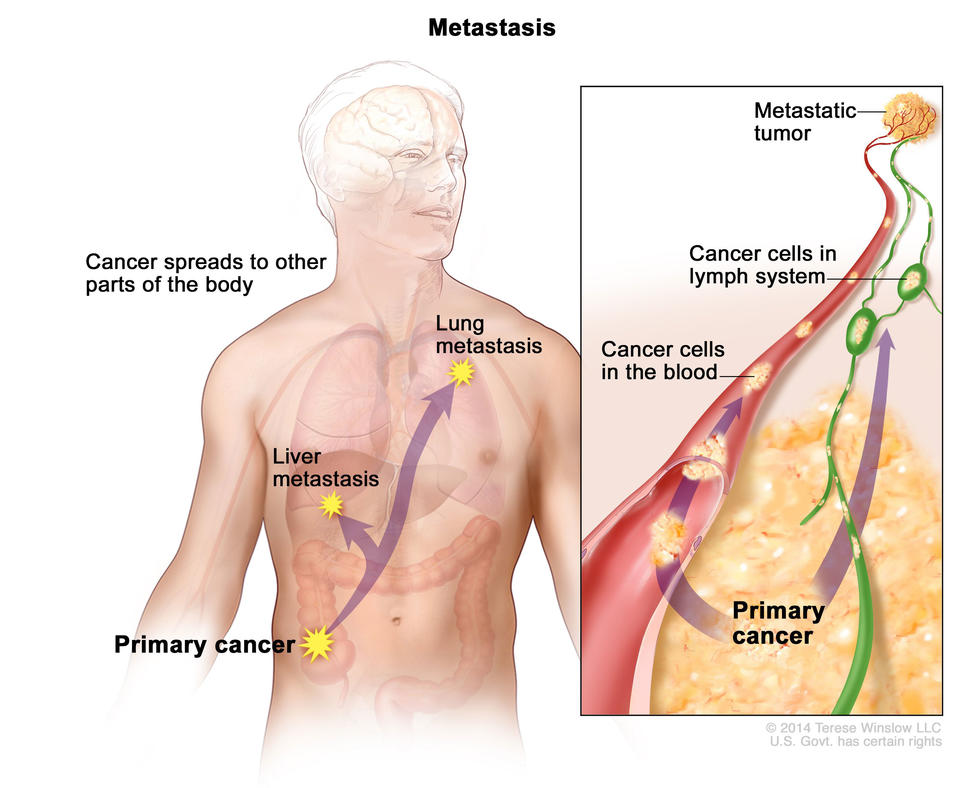
A cancer that has spread from the place where it first formed to another place in the body is called metastatic cancer. The process by which cancer cells spread to other parts of the body is called metastasis.
Benign tumors do not spread into, or invade, nearby tissues. When removed, benign tumors usually don’t grow back, whereas cancerous tumors sometimes do. Benign tumors can sometimes be quite large, however. Some can cause serious symptoms or be life threatening, such as benign tumors in the brain.
The first process in metastasis is break off of small situ tumors through basement membrane which is followed by a process called intravasion where tumor cells force their way through capillaries or lymphatics into the circulatory system then this small tumor masses are transported through the blood or lymphatic system. After transportation, the next step is extravasion where the cancer cells push through the walls of capillary or lymphatics into tissues. After extravation the cells can then activate their proliferation pathways and form small tumor mass.
This process has been shown by carcinoma cells which activate differentiation circuit called the EMP(epithelial to mesenchyme transition) by inducing expression of EMT permissive transcription factors .this enables the cancer cells to gain characteristics of mesenchyme cells such as invasiveness and motility.
Cancer can start almost anywhere in the human body, which is made up of trillions of cells.
Cancers are caused by combined genetic and non-genetic changes induced by environmental factors that trigger inappropriate activation or inactivation of specific genes leading to neoplastic transformations, or abnormal cell growth.
 BIOTECH FOR GOOD